Add your promotional text...

Reviews - Hang On
Editorial Review
The Book Revue
Five Stars
Customer Reviews
Writing my first review because of this book!
Hang On is so beautiful it's like reading poetry. I fell in love with the main characters & also loved the way Ms. Gavin weaves their experiences in with real rock stars' lives. I read compulsively & often can't remember a book days later. This book will stay in my heart for a long time.
I wish it wouldn't end
Nell Gavin is a wonderful author. When you're reading her books, it's like you're having a long talk with an old friend. "Hang On" is a beautifully written story about tragedy, love, hope, and rock n roll. Give it a chance, you won't be sorry!
A Real Page Turner
HANG ON is a real page turner. You immediately get vested in Holly's life. You cheer when she finally lets Trevor into her heart (one careful step at a time). Your heart hurts when Holly suffers due to her mental state. But what I really found fascinating was the back story about touring with a famous British rock band. Nell Gavin describes what I always wondered. What was it like to be a groupie in the 70's? What were the tour and the backstage scene really like....
The seventies happened a long time ago, and that decade’s culture isn’t entirely accessible to people who didn’t live through it, because the world has changed so much. For this reason, Hang On requires a little bit of an introduction, so you can understand the world as it was in 1973, without superimposing today’s values and societal expectations onto that historical period. It was a different world.
In 1973, rock stars were godlike beings who draw tens of thousands of worshipful fans to their concerts, traveling the world with supporting crews of dozens of people. Backstage at the venue was an ultra-exclusive party, and a backstage pass was a golden ticket to that rarified environment. The rock and roll world was insular and exclusive, and the bands—and their crews—were the targets of hundreds, if not thousands of women around the world, who strove for backstage access to the performance venues to obtain entry into that world. These were the “groupies,” a relatively new phenomenon in entertainment at the time, and they were legendary. It was all fascinating to witness. In Hang On I attempted to describe it to you, because I was there.
In 1973, women earned 56.6% of what men made and had virtually no path to career advancement or good-paying jobs, even with a college degree. “Supervisor” was typically a woman’s highest aspiration in the corporate world; that was the “glass ceiling” I’m sure you’ve heard about. Newspapers still published separate classified ad sections for “men” and “women.” A woman was disqualified at the outset for a “man’s” job, or else received only roughly half the salary a man would receive, were she to somehow obtain one. Once in that role, her male coworkers would frequently ridicule, bully, or sabotage her to prove she couldn’t handle the job and to drive her out.
So, a self-supporting woman with no outside financial support lived in poverty, by default. To illustrate, my Social Security earnings record shows that I earned $3,136 in 1973 working full time. That was a very typical salary for a female who was new to the workforce and hadn’t earned raises over time, so I didn’t really have the option of “trading up” for a higher paying job. (I also had no “home” to go back to. I was on my own.) Converted to today’s dollars (2026), I earned $23,521 before taxes and health insurance premiums. My rent for a tiny two-room apartment was only $120 a month including utilities and cockroaches, low by 1973 standards, because I lived in a dicey neighborhood where rent was cheap. Converted to today’s currency, I paid $909 a month. There was very little money left over for food, so hunger was a way of life. In Hang On I described that experience to you as well.
In 1973, soldiers were returning from the Vietnam war with PTSD. However, that condition did not have a name yet, nor was there any official treatment plan to address it. Veterans simply suffered, and many of them were committing suicide.
During the seventies people pushed the medical world to finally recognize the devastating effects of battlefield trauma, and to find some way to treat it. It would be many more years before the adverse effects of trauma that the rest of us experienced would earn a diagnosis. “Civilian trauma” was baffling to therapists, because it sometimes manifested with symptoms of PTSD, sort of, but victims displayed other symptoms that were unique, and they did not respond to drugs. The psychiatric community did not draw a parallel with PTSD for a long while, because the source of some trauma is insidious and long term, and some of that trauma results from neglect, not wartime explosions. However, it is just as devastating as battleground trauma. It took time for them to recognize that PTSD does not require bombs, and to define one of its variations as “Complex PTSD.”
In 1973, there was no course of treatment for a nineteen-year-old girl who had experienced the emotional fracture of Complex PTSD from sustained long-term trauma. I described that to you too, because it happened to me.
They also did not recognize at the time the connection between poor diet and clinical depression. That revelation was years, if not decades, away.
In 1973, the “sexual revolution” was new and there was nothing to slow its momentum, because AIDS was still a decade away. The late sixties had introduced the concept of “free love.” Birth control pills had just recently become readily accessible. These two things opened the floodgates for men, who felt entitled to demand, and sometimes force, sexual favors from women. Women were still conditioned to view men as “superior,” and were pressured and conditioned by society to be “nice” and “compliant,” so they were ill-equipped to defend themselves or advocate for themselves yet; they were only just learning how, in 1973.
In 1973, men were forceful. They were persistent. They did not accept “no” for an answer, and they took full advantage of their “superior” position in society. They were everywhere. Women had to navigate a frequently hostile world surrounded by predators, particularly in urban environments, particularly in nightclubs and bars, and most particularly if they were exceptionally attractive. There was no term for “date rape” in the seventies. We simply called it “a date.” Women in 2026 still deal with harassment—I see the online videos—but it was systemic, and it was pervasive, and it was frightening in the seventies. In Hang On I described that behavior, because it was the constant background noise and the backdrop of life in 1973. The reality was far worse than my descriptions.
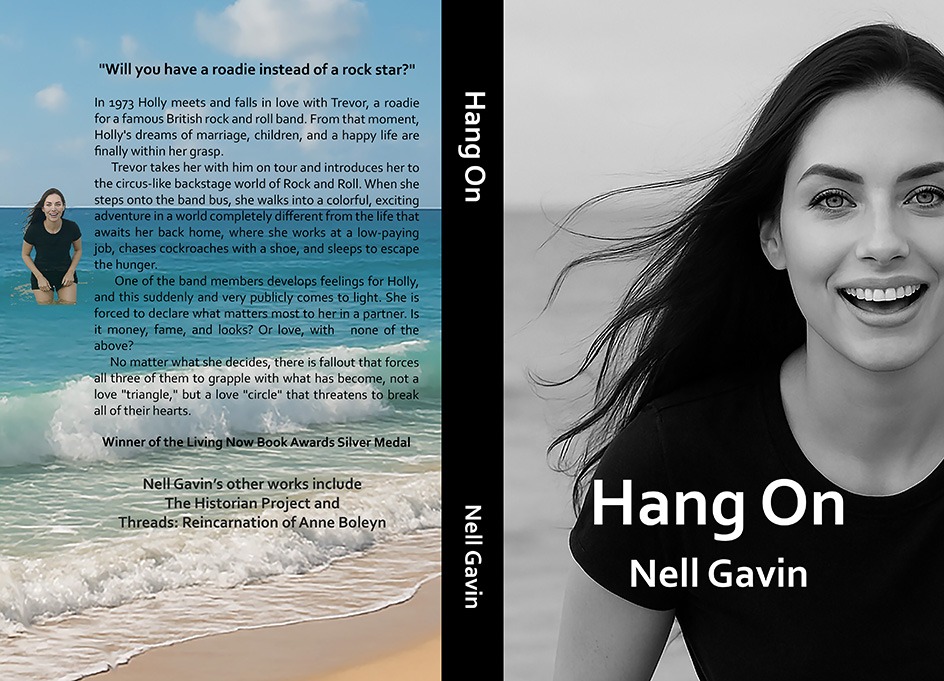
Hang On is a story about a nineteen-year-old woman, Holly, who lives in 1973, in that world. Trevor is a roadie for a famous rock band, and the two of them meet and fall in love. Their relationship is complicated by Holly’s trauma-induced emotional fracture, which she attempts to hide from Trevor, and by John, the rock band’s bass guitarist, who develops feelings for her.
Holly is beautiful. John is rich and famous. Trevor has neither looks, nor power and wealth—but he can provide access to people like John. All of them have personal insecurities that make them worry that those assets are the only things people want from them. They each wonder if they would be lovable at all without those assets, because they are so accustomed to being “used.”
The three of them inadvertently form a “love circle” (not a “love triangle”) then demonstrate in a major theme of the story that none of those external superficial things mean anything to any of them… because love is love.